The Hidden Cost of Cloud Vendor Lock-In in UK Public Sector Data Platforms

The Hidden Cost of Cloud Vendor Lock-In in UK Public Sector Data Platforms
By Rplus Analytics · Cloud Strategy · UK Public Sector
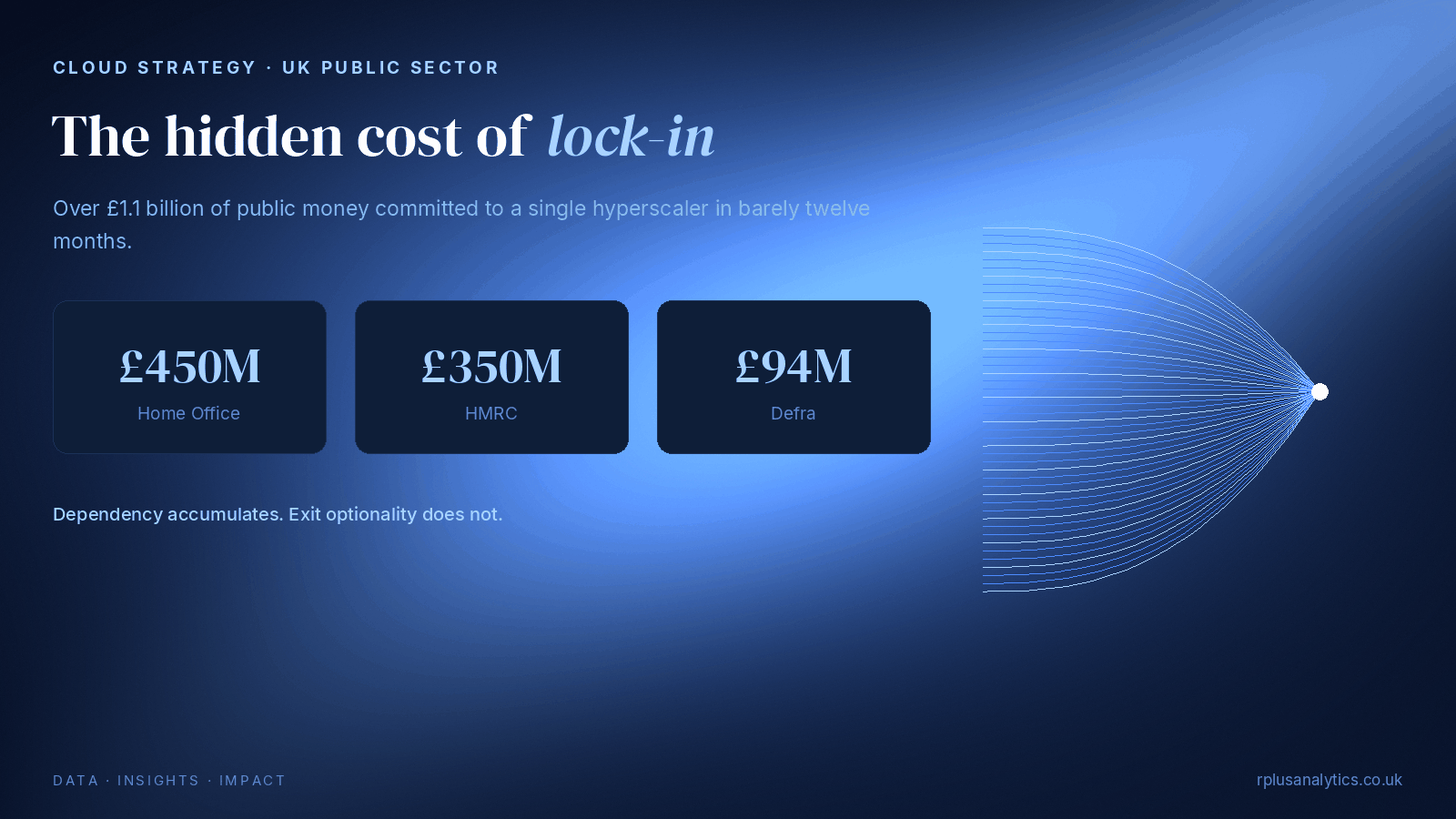
UK government departments are signing some of the largest cloud contracts in their history. Recent deals tell the story plainly: roughly £450M at the Home Office, £350M at HMRC, and £94M at Defra — over £1.1 billion of public money committed to a single hyperscaler in barely twelve months. Each contract on its own can be defended on the merits. Taken together, they describe a procurement pattern that is quietly narrowing the country's negotiating position. (PRJ8500)
That pattern is vendor lock-in, and it's the single biggest unspoken risk in public sector data architecture today.
What lock-in actually looks like
Lock-in is rarely a single decision. It accumulates. A team picks a managed ingestion service because it integrates cleanly with the storage layer they've already chosen. The data warehouse is selected because it shares an IAM model with the rest of the estate. Power BI, dashboards, ML notebooks, and governance tooling all settle into the same provider's ecosystem because doing otherwise would mean rebuilding integration plumbing from scratch.
By year three, the platform is no longer "running on" a cloud. It is the cloud. Migrating away would mean rewriting ingestion pipelines in a different dialect, re-implementing security controls in a different IAM model, retraining engineers, and retiring years of dashboards built against proprietary SQL extensions. The exit cost is so high that the renewal conversation is over before it starts. DSA PRJ8500
This is the lock-in level the major hyperscalers carry today, in our assessment:
| Cloud | Lock-In Level | Why |
|---|---|---|
| AWS | High | Heavy reliance on proprietary services; Glue and EMR are tightly coupled to the AWS control plane |
| Azure | High | Deep integration between ADLS, Synapse/Fabric, and Azure ML |
| GCP | Medium | Some open components (Dataproc, BigQuery SQL) but still Google-optimised |
| Oracle Cloud | High | Strong gravitational pull toward Oracle-native databases and pipelines |
Why this matters more in public sector
Private firms can sometimes absorb lock-in as a cost of speed. Public sector organisations cannot, for three reasons specific to how they operate.
Negotiating position. When a department's entire analytics estate runs on one provider, the renewal conversation is not really a negotiation. The provider knows the migration cost, and prices accordingly. Multiplied across central government, this is a structural disadvantage worth hundreds of millions over a decade. (DSA)
Cross-departmental data sharing. UK government increasingly needs data to flow between departments — fraud detection, benefits administration, public health, policy evaluation. When two departments standardise on different hyperscalers, every cross-departmental analysis becomes an integration project rather than a query.
Audit and continuity. Public sector platforms are scrutinised on a longer horizon than commercial ones. Architectural decisions made in 2025 will be audited against 2035 outcomes, by which point the cloud market will look different. Designs that assume today's provider lineup will still be optimal a decade out have a poor track record.
What "cloud-agnostic" actually means (and doesn't)
Cloud-agnostic does not mean refusing to use cloud-native services. It means designing so that the valuable parts of the platform — the data, the transformation logic, the governance model, the access controls — are portable, even if some operational glue is provider-specific.
Concretely, it means:
- Storage in open table formats (Delta Lake, Apache Iceberg, Apache Hudi) on object storage, rather than proprietary warehouse-internal formats
- Transformation logic written against portable engines (Spark, Snowpark, ANSI SQL) rather than provider-specific dialects
- A unified governance and catalog layer that travels with the data
- Decoupled storage and compute, so each can scale — or be replaced — independently
Done well, this gives the department a credible threat: if the renewal pricing isn't right, the workload genuinely can move. That credibility is, in itself, the negotiating leverage.
Where to start
If you're a data leader inside a UK department or arms-length body and lock-in is becoming a concern, three early moves matter most:
- Audit your portability ratio. What percentage of your platform — by code volume, by storage cost, by user-facing surface — would survive a provider migration unchanged? Most teams are surprised by the answer.
- Move new workloads to open table formats first. Don't try to migrate everything. Let new pipelines land on Delta or Iceberg from day one, and let the old proprietary estate run down naturally.
- Centralise governance before centralising compute. A governance layer that already abstracts across providers makes everything downstream easier.
Rplus Analytics has supported UK central government data platforms since 2012. We help public sector organisations design cloud architectures that preserve negotiating power, support cross-departmental data sharing, and survive contract renewals intact. If you'd like to talk through your current platform, get in touch.