
Introducing BidIntel — Rplus Analytics' AI-Native Platform for UK Public Sector Procurement Intelligence
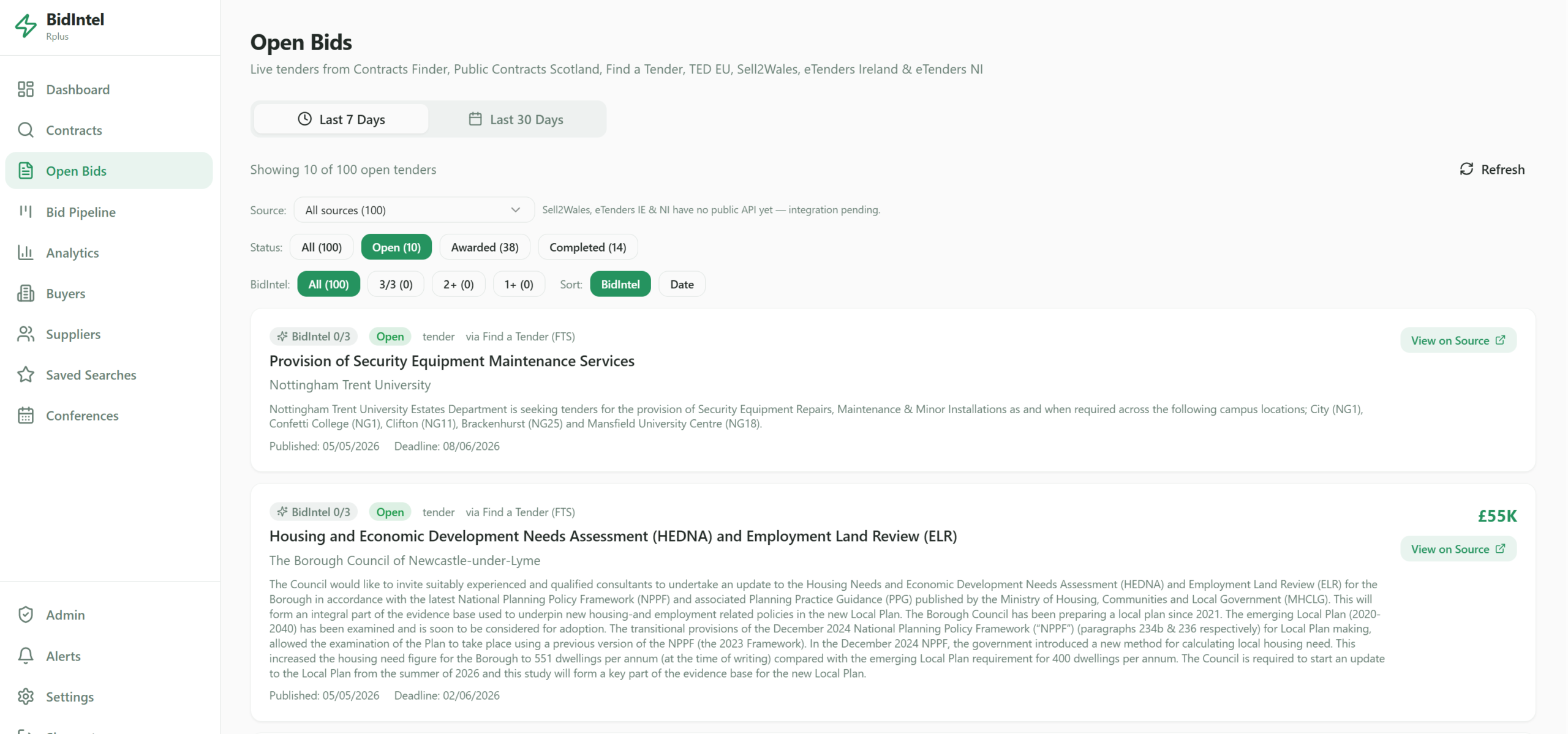
The UK public sector publishes more procurement information than any supplier can realistically read. Every working day, thousands of notices, awards, planning indicators, and framework competitions move through Contracts Finder, Find a Tender, departmental portals, and Crown Commercial Service. The signal is in there — but extracting it manually is a full-time job most suppliers cannot afford to do. BidIntel, the platform we are building at Rplus Analytics, is designed to fix that.
Why we are building BidIntel
Rplus Analytics has spent more than a decade working alongside UK public sector data and analytics teams. One pattern has stayed constant across that time: the suppliers who win in this market are not always the ones with the best capability. They are the ones who see opportunities earliest, qualify them fastest, and respond with the sharpest signal.
Most suppliers — particularly SMEs — lose on those three steps before capability ever enters the conversation. They find out about a £350 million procurement when it hits the press. They start qualification when the ITT arrives, not when the planning notice was published twelve months earlier. They write generic capability statements because they did not have time to read the buyer's published strategy, framework alignment, or capability framework references.
BidIntel exists to compress that gap. It reads the entire UK public sector procurement landscape, continuously, and turns it into structured, qualified intelligence that suppliers can actually act on.
What BidIntel does
At its core, BidIntel does four things.
1. Monitors the full UK public sector procurement landscape. Contracts Finder, Find a Tender Service, Crown Commercial Service framework feeds, departmental portals, and the Open Contracting Data Standard records that sit underneath them. Every published notice — planning, market engagement, contract notice, award, and modification — is ingested, parsed, and structured.
2. Extracts and enriches the underlying signal. A raw procurement notice is rarely useful in its published form. BidIntel parses each notice for the information that actually matters to a supplier deciding whether to engage — buyer, value, lot structure, framework route, capability framework references, security and clearance expectations, SME supply chain language, indicative timelines, and the broader strategic context the buyer has signalled in their published documents.
3. Qualifies opportunities against the supplier's actual capability. Generic alerts are noise. BidIntel allows suppliers to define their capability profile — sectors, frameworks, SFIA and DDaT mappings, security posture, geographic coverage, partner appetite — and qualifies each opportunity against that profile. A supplier sees the procurements that genuinely match, with a clear read on why they match.
4. Turns intelligence into bid-ready briefings. For each qualified opportunity, BidIntel generates a structured briefing — what the procurement is, how it is structured, what the buyer has signalled about evaluation priorities, where the supplier's capability aligns, and what gaps would need to be closed (alone or through partnership) to bid credibly.
The platform is AI-native. The same reasoning capability that allows large language models to read a published Digital, Data and Technology strategy and connect it to an associated framework competition is what makes the qualification step possible at scale. This is not keyword matching. It is structured reading of the entire procurement context around an opportunity.
Who BidIntel is for
BidIntel is being built primarily for three groups of users.
SMEs in the UK technology and services market. SMEs without dedicated bid teams or expensive procurement intelligence subscriptions are the clearest beneficiaries. BidIntel surfaces the right opportunities — including the supply chain opportunities under Prime Delivery Partner arrangements that SMEs are often invited into structurally but rarely positioned for in time.
Bid and capture teams inside Primes and mid-market suppliers. Larger suppliers do have intelligence subscriptions, but most of those tools surface notices rather than qualified intelligence. BidIntel is built to give bid teams the structured reading of a procurement they would otherwise produce manually — faster, and consistently across opportunities.
Partnership and channel teams looking for the right SMEs. The reverse direction also matters. Primes assembling supply chains for major procurements need to find credible SME partners with specific capability mappings. BidIntel's structured supplier capability profiles support that side of the market too.
A worked example: PRJ 8500
To illustrate what BidIntel produces in practice, consider one of the most significant UK public sector data and analytics opportunities currently in the market — published on Contracts Finder under the reference PRJ8500. PRJ8500: DSA - Data & Analytics Services https://www.contractsfinder.service.gov.uk/Notice/27e0eb43-4712-463b-bd9f-f1d4ed672fa9
The published notice on its own is a long, dense document. Read manually, it takes a bid analyst meaningful time to extract what actually matters. Read through BidIntel, the structured briefing surfaces the signals that drive a bid/no-bid decision in minutes:
- Scale and shape. A planned £350 million indicative total across two lots, over a maximum five-year term (four plus an optional one).
- Lot structure. Lot A — capped at approximately £200 million — for outcome-based, multifunctional team delivery. Lot B — capped at approximately £150 million — for data professions resourcing.
- Commercial route. Further competition under the Crown Commercial Service Digital Specialists and Programmes framework, RM6263, Lot 1 (Digital Programmes). Eligibility filtered to suppliers already on that framework.
- Capability framing. Explicit alignment to SFIA and the UK Government Digital and Data Profession Capability Framework. Bid evaluation will use that capability vocabulary, not suppliers' own.
- Governance posture. The Government Data Ethics Framework is referenced as a governance reference point — a signal that ethical and bias-control narratives will be part of evaluation, not a compliance afterthought.
- SME supply chain language. Prime Delivery Partners are explicitly expected to work with SME supply chains as a structural part of delivery.
- Strategic context. The buyer's published Digital, Data and Technology strategy sets the broader direction the procurement is funding — useful context for any supplier writing a credible response.
For a Prime considering Lot A, BidIntel's briefing supports a fast bid/no-bid call and a clear view of which SME partners would strengthen the consortium. For an SME, the same briefing supports an equally fast read on whether the procurement is realistically addressable, and which Primes are likely to be assembling supply chains.
This is what BidIntel does for every qualified opportunity in the UK public sector market — at the volume and pace the market actually moves at.
Where BidIntel is in development
BidIntel is at MVP stage. The ingestion and parsing layers are operational against Contracts Finder and the Open Contracting Data Standard records that sit beneath it. The qualification and briefing layers are in active development. We are working with a small group of early users — a mix of SMEs and bid teams inside larger suppliers — to refine how qualification and briefing work against real bid decisions.
The product currently lives at bidinteluk.lovable.app. Suppliers interested in early access, or in shaping how BidIntel handles their specific category of work, can reach out to us through the platform or via the contact route on the Rplus Analytics site.
Why this matters for the wider UK Data Services and Analytics market
BidIntel is a product, but it is also a thesis. We believe the UK public sector procurement market is large enough, structured enough, and consequential enough that suppliers — especially SMEs — should not be losing on visibility and qualification before capability is ever assessed. The frameworks, the published strategies, the capability profiles, and the open contracting data are all there. What has been missing is the layer that reads them, continuously, in the way a senior bid analyst would.
For more on how Rplus Analytics works with UK organisations across data and AI, see our data services and analytics page.
Frequently asked questions
What is BidIntel? BidIntel is an AI-native UK public sector procurement intelligence platform being built by Rplus Analytics. It monitors UK public sector procurement sources, extracts structured intelligence from each notice, qualifies opportunities against the supplier's capability profile, and produces bid-ready briefings.
Who is BidIntel for? SMEs in the UK technology and services market, bid and capture teams inside Primes and mid-market suppliers, and partnership teams assembling SME supply chains for major procurements.
Is BidIntel available now? BidIntel is at MVP stage, with early users actively shaping the product. Suppliers interested in early access can reach out via bidinteluk.lovable.app.
How is BidIntel different from existing tender alert tools? Most existing tools surface notices. BidIntel reads the procurement context around each notice — published strategies, framework references, capability profile expectations, and supply chain language — and produces structured, qualified briefings rather than keyword-matched alerts.
What is PRJ 8500, referenced in the article? PRJ8500 is the Open Contracting reference for a planned £350 million UK public sector Data Services and Analytics procurement, used here as a worked example of the kind of opportunity BidIntel structures for users.